
What High-Performance Racing Teaches Us About B2B Growth
SCUDERIA PARTNERS | INSIGHTS & PERSPECTIVES
Strategy, Precision, Teamwork, and the Pursuit of Sustainable Growth
GROWTH STRATEGY
Winning in high-performance racing requires more than a fast car or a talented driver. Success depends on strategy, engineering, teamwork, technology, disciplined execution, and the ability to adapt as conditions change. The same principles apply to building a high-performing B2B marketing and sales organization.
High-performance motorsports represent one of the most demanding examples of coordinated execution.
Behind every competitive race car is an organization responsible for strategy, design, engineering, operations, performance analysis, and continuous improvement.
Drivers may receive the most attention, but they are supported by teams of specialists working toward a shared objective.
The same is true in business.
Successful B2B organizations depend on more than individual sales performance or a well-executed marketing campaign. They require a coordinated commercial strategy, capable leadership, clearly defined responsibilities, effective technology, and processes that connect customer acquisition with long-term relationships.
Just as racing teams continuously refine their performance, businesses must evaluate results, identify opportunities for improvement, and adapt to changing market conditions.
The strongest commercial organizations operate like high-performance teams: every component has a purpose, every role contributes to the outcome, and success depends on how effectively the entire system works together.
1. Winning Begins With a Clear Strategy
A professional racing team does not arrive at a circuit without a plan.
Long before the race begins, leadership evaluates objectives, competitive conditions, technical capabilities, available resources, and the strategy most likely to produce a successful result.
Decisions about equipment, personnel, preparation, and race execution must support the overall plan.
B2B organizations face similar requirements.
Before launching campaigns, hiring salespeople, or investing in new technology, leadership should establish a clear commercial strategy.
That strategy should define:
- Revenue growth objectives and business priorities.
- Target markets and ideal customer profiles.
- Competitive positioning and differentiated value propositions.
- Go-to-market channels and customer acquisition approaches.
- Marketing and sales resource requirements.
- Performance measures and accountability.
Without a clear strategy, organizations risk pursuing disconnected initiatives that consume resources without creating consistent commercial results.
Marketing may focus on awareness while sales pursues different customer segments. Teams may adopt technologies without understanding how they support business objectives.
A strong strategy provides direction and ensures that individual activities contribute to shared goals.
In racing and business, speed matters—but moving quickly in the wrong direction does not create a competitive advantage.
2. Build the Right Team for the Challenge
A competitive racing organization brings together professionals with highly specialized capabilities.
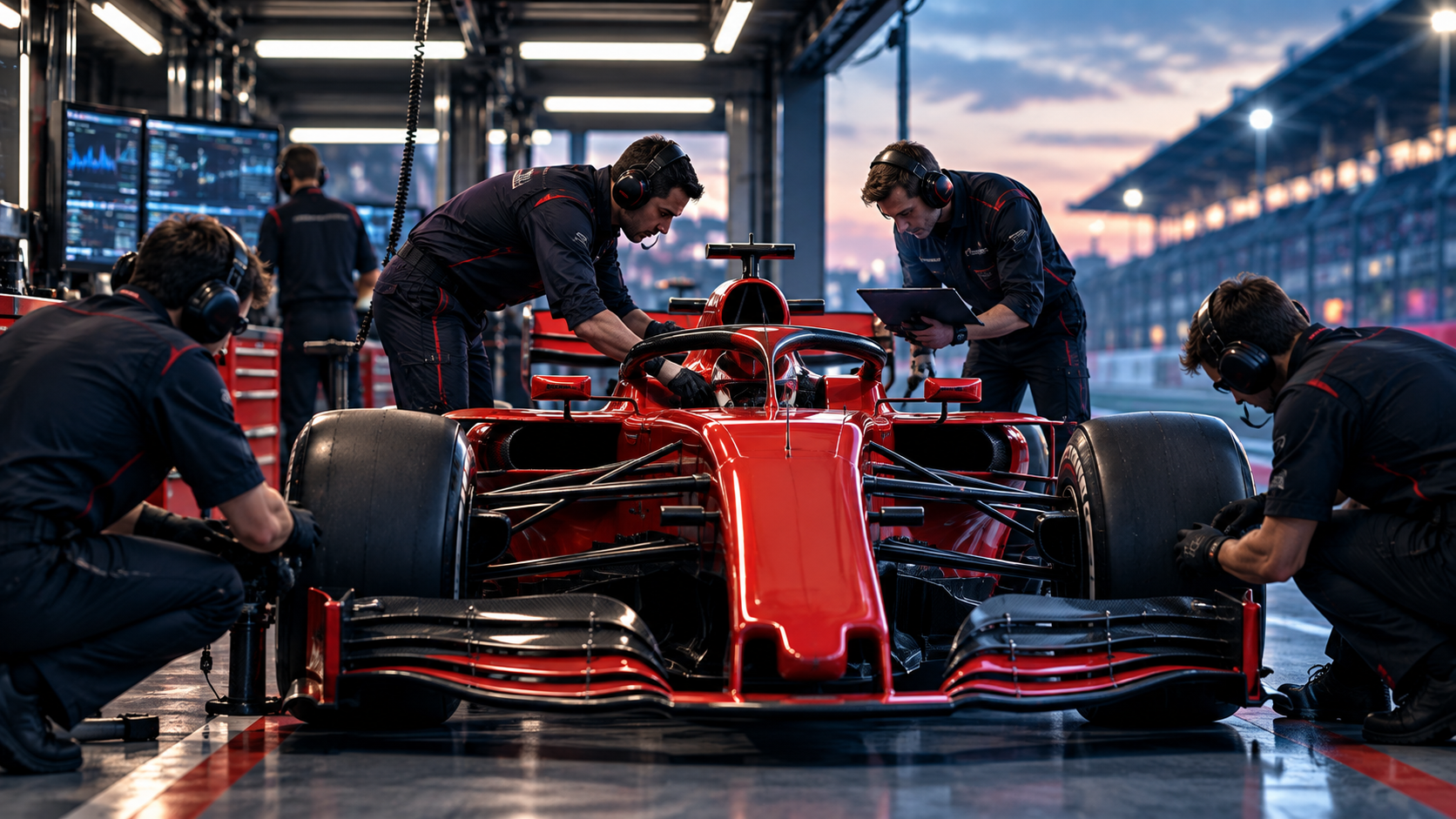
Engineers design and optimize the car. Mechanics prepare and maintain it. Strategists analyze race conditions. Pit crews execute precise operations under intense time pressure. Drivers translate the team’s preparation into performance on the track.
Each function requires different skills, but all contribute to the same objective.
B2B marketing and sales organizations require a similar combination of complementary expertise.
Depending on the business, these capabilities may include:
- Commercial leadership: Establishing strategy, priorities, and performance expectations.
- Marketing: Building market awareness, communicating value, and generating demand.
- Business development: Identifying prospects and creating qualified opportunities.
- Sales: Developing customer relationships and converting opportunities into revenue.
- Account management: Strengthening existing relationships and identifying expansion opportunities.
- Customer success and delivery: Ensuring that commitments translate into meaningful customer outcomes.
- Revenue operations: Supporting processes, systems, reporting, and commercial efficiency.
Expecting every employee to perform all these responsibilities equally well is rarely an effective long-term model.
As organizations grow, specialization can improve productivity, accountability, and the customer experience.
However, specialization must be accompanied by collaboration.
A racing team cannot succeed if engineering, strategy, and pit operations work independently. Likewise, a business cannot consistently deliver strong results when marketing, sales, and customer-facing functions operate in isolation.
The objective is not simply to hire talented individuals. It is to assemble a team whose capabilities work together to achieve the organization’s commercial goals.
3. Every Component Must Work Together
A race car is an integrated system.
The engine, aerodynamics, suspension, tires, electronics, and countless other components must operate together to deliver performance.
Improving one component does not necessarily improve the entire car if other elements cannot support the change.
B2B revenue generation operates in much the same way.
Marketing campaigns, prospecting, lead qualification, sales processes, customer onboarding, and account management are interconnected.
Consider an organization that increases marketing investment and generates significantly more inquiries.
If sales lacks the capacity or processes to follow up effectively, the additional demand may not produce meaningful revenue growth.
Similarly, a strong sales team may struggle if the organization lacks clear positioning, relevant marketing support, or reliable customer information.
Businesses should therefore evaluate commercial performance across the entire customer lifecycle:
- Market awareness and prospect engagement.
- Lead generation and qualification.
- Opportunity development and sales conversion.
- Customer onboarding and delivery.
- Retention, account expansion, and advocacy.
Each stage should have clear ownership, defined processes, and measurable outcomes.
More importantly, the transitions between stages must work effectively.
Commercial performance depends on optimizing the entire revenue engine, not simply improving individual departments.
4. Technology Creates Advantage When Properly Integrated
Technology has transformed high-performance racing.
Advances in materials, engineering, electronics, simulation, and data analysis have changed how teams design, prepare, and operate their cars.
However, technology alone does not guarantee success.
Teams must understand how to apply it, interpret the information it provides, and integrate it into broader performance objectives.
The same principle applies to commercial technology.
Modern B2B organizations have access to CRM platforms, marketing automation, analytics, sales engagement systems, and increasingly sophisticated artificial intelligence capabilities.
These tools can support activities such as:
- Managing customer and prospect information.
- Coordinating marketing campaigns and sales outreach.
- Monitoring pipeline development and forecasting revenue.
- Analyzing customer engagement and buying behavior.
- Automating appropriate administrative processes.
- Supporting content development and sales enablement.
- Identifying opportunities to improve commercial productivity.
Yet adding more software does not necessarily create better results.
Disconnected systems, inconsistent data, limited employee adoption, and unclear processes can reduce the value of even sophisticated platforms.
Organizations should evaluate technology based on how effectively it supports their commercial strategy and improves execution.
Artificial intelligence offers additional opportunities to improve research, analysis, personalization, and workflow efficiency, but it also requires appropriate oversight, data protection, and quality controls.
Technology should strengthen the commercial team, not become a substitute for strategy, judgment, or customer relationships.
5. Data Drives Better Decisions
Racing teams rely on extensive performance information to understand how their cars and drivers are operating.
Data helps identify technical issues, evaluate strategy, understand competitive performance, and support decisions during rapidly changing conditions.
Successful B2B organizations should take a similarly disciplined approach to commercial measurement.
Leadership needs reliable information about marketing effectiveness, sales pipeline development, customer acquisition, and revenue performance.
Important measures may include:
- Qualified pipeline creation and pipeline coverage.
- Lead-to-opportunity and opportunity-to-customer conversion rates.
- Sales cycle length and pipeline velocity.
- Marketing contribution to commercial opportunities.
- Customer acquisition costs and commercial efficiency.
- Customer retention, renewal, and account expansion.
- Revenue growth and forecast accuracy.
However, collecting more information is not the same as making better decisions.
Organizations should focus on measures that help explain performance and identify actions that can improve results.
For example, a decline in revenue may result from insufficient pipeline creation, lower conversion rates, longer sales cycles, reduced deal values, or customer retention challenges.
Each issue requires a different response.
Effective commercial leadership uses data to diagnose problems rather than relying exclusively on assumptions or activity counts.
The purpose of measurement is not simply to report performance. It is to understand what is happening, why it is happening, and what should change.
6. Execution and Timing Can Determine the Outcome
In high-performance racing, a well-designed strategy can be undermined by poor execution.
A delayed pit stop, communication breakdown, or incorrect decision at a critical moment can affect the result of an entire race.
Successful teams prepare extensively, establish clear responsibilities, and practice important processes so that execution remains consistent under pressure.
Business growth requires similar discipline.
A compelling marketing campaign has limited value if qualified prospects are not contacted promptly.
A strong sales presentation may not produce results if proposals are delayed or customer requirements are poorly understood.
Even a successful sale can become a difficult customer relationship if onboarding and delivery are not coordinated.
Commercial execution improves when organizations establish:
- Clear processes for prospect and customer engagement.
- Defined responsibilities across marketing and sales.
- Consistent lead qualification and follow-up standards.
- Reliable communication between commercial and operational teams.
- Effective opportunity management and forecasting practices.
- Structured customer onboarding and account handoffs.
These processes should support employees rather than create unnecessary bureaucracy.
The objective is to improve consistency while preserving the flexibility needed to respond to individual customer requirements.
Strong strategy creates opportunity. Disciplined execution converts opportunity into results.
7. Adapt Quickly When Conditions Change
Racing conditions rarely remain constant.
Weather, track conditions, tire performance, competitive decisions, and unexpected events can require teams to modify their plans.
The ability to recognize changing conditions and respond effectively is an important competitive capability.
B2B markets are equally dynamic.
Customer priorities evolve. Competitors introduce new offerings. Economic conditions change. Technology creates new possibilities, and regulatory developments can alter business requirements.
Organizations that rely on static annual plans without reviewing performance may struggle to respond.
Effective commercial teams should regularly evaluate:
- Changes in customer demand and purchasing behavior.
- Emerging competitors and market developments.
- Campaign performance and channel effectiveness.
- Pipeline health and revenue forecasts.
- Product-market fit and value proposition relevance.
- Team capabilities and resource requirements.
These reviews should inform adjustments to targeting, messaging, investments, and execution priorities.
Adaptability does not mean changing direction constantly. It means maintaining a clear strategy while making informed adjustments when evidence indicates that conditions have changed.
The most resilient organizations combine strategic consistency with operational flexibility.
8. Continuous Improvement Creates Competitive Advantage
High-performance racing teams continuously evaluate opportunities to improve.
Engineering changes, operational refinements, driver feedback, and performance analysis contribute to an ongoing development process.
Even successful teams recognize that maintaining a competitive position requires continued improvement.
B2B organizations should apply the same mindset to marketing and sales.
Rather than viewing a campaign, sales process, or organizational structure as permanent, leadership should regularly examine what is working and what can be improved.
Opportunities may include:
- Refining target customer profiles and market segmentation.
- Improving marketing messages and campaign performance.
- Strengthening lead qualification and sales follow-up.
- Reducing friction in the customer buying process.
- Improving collaboration between marketing, sales, and delivery.
- Developing employee skills and leadership capabilities.
- Optimizing technology utilization and reporting.
Continuous improvement should be structured around measurable objectives.
Teams should identify opportunities, implement changes, evaluate outcomes, and apply what they learn to future decisions.
Not every experiment will succeed. However, organizations that learn systematically from both successes and setbacks can strengthen their commercial capabilities over time.
Competitive advantage is often built through a series of disciplined improvements rather than one dramatic change.
9. Leadership Connects Strategy With Performance
Behind every successful racing team is leadership responsible for bringing together people, resources, technology, and strategy.
Leaders must establish priorities, make difficult decisions, manage budgets, and ensure that the organization remains focused on its objectives.
The same responsibilities exist in B2B commercial organizations.
Effective marketing and sales leadership must connect strategic planning with day-to-day execution.
That includes:
- Defining a clear commercial vision and growth strategy.
- Building and developing the right organizational capabilities.
- Aligning marketing, sales, and customer-facing functions.
- Allocating resources according to business priorities.
- Establishing performance expectations and accountability.
- Supporting informed decisions through reliable data.
- Encouraging collaboration, learning, and adaptability.
Not every business has the resources or immediate need to build a complete internal commercial leadership structure.
Fractional executive leadership and outsourced marketing or sales expertise can provide additional capabilities during periods of growth, transformation, or market expansion.
These models can help organizations access specialized experience while maintaining flexibility in how commercial resources are deployed.
Regardless of the organizational model, clear leadership and accountability remain essential.
Successful commercial leadership is not simply about directing individual functions. It is about ensuring that the entire organization works together to achieve sustainable growth.
10. Sustainable Success Requires More Than a Single Victory
Winning a race is an achievement. Remaining competitive over an entire season requires consistency, preparation, and the ability to perform under different conditions.
B2B growth follows a similar pattern.
One successful campaign, major customer agreement, or strong sales quarter can create momentum, but it does not guarantee long-term success.
Sustainable revenue growth depends on developing repeatable commercial capabilities.
Organizations must continue generating opportunities, converting prospects into customers, delivering value, and strengthening existing relationships.
They must also invest in the people, processes, and technologies needed to support future growth.
A successful commercial operating model should therefore balance immediate performance with long-term organizational development.
Short-term revenue objectives are important, but they should not undermine customer relationships, employee capabilities, or the systems required for continued success.
The objective is not simply to win the next deal. It is to build an organization capable of delivering strong commercial performance repeatedly.
Building a High-Performance B2B Growth Engine
High-performance racing provides a useful perspective on what it takes to build a successful business.
Strategy establishes direction. Specialized teams bring the necessary capabilities. Technology supports performance. Data informs decisions. Disciplined execution turns preparation into results.
Continuous improvement and adaptability help organizations remain competitive as conditions change.
For B2B businesses, these principles translate into an integrated marketing and sales organization designed to acquire customers, develop relationships, and generate sustainable revenue growth.
Every commercial function has a role to play, but the greatest value comes from how effectively those functions work together.
Just as a winning racing team depends on the performance of the entire organization, a successful business depends on aligning strategy, people, technology, and execution around a common objective.
The checkered flag may mark the end of a race, but in business, the pursuit of better performance never truly ends.
Build Your High-Performance Growth Engine
Scuderia Partners helps B2B organizations bring together strategy, marketing, sales, technology, and execution to create more effective commercial operations.
Through fractional executive leadership, outsourced sales and marketing expertise, and integrated go-to-market support, we help businesses strengthen performance and pursue sustainable revenue growth.
Ready to accelerate your business growth?